Table of Contents
This guide covers how to care for cows, sheep, and alpacas in Story of Seasons: Friends of Mineral Town (SoS: FoMT), including how to obtain high-quality Milk and Wool with higher selling prices.
All three animals can be purchased from Yodel Ranch. Adult cows produce Milk every day, while sheep and alpacas can be sheared every seven days to obtain Wool.
The sheep and alpacas sold by Mugi are already adults, while the cows he sells are still Calves. Cows will become adults after nine days if they are fed every day.
If you miss feeding an animal for one day, its growth time will increase by one day, up to a maximum of 14 days.
The Barn’s capacity can be upgraded by ordering a renovation at the Workshop. The renovation requires 400 Lumber, 250 Material Stone, and 6,800 G. The renovation takes three days to complete.
Once the renovation is complete, the Barn can hold up to 16 livestock and will have two breeding pens.
Saibara will also begin selling the Cheese Maker, Butter Maker, and Yarn Maker after the renovation is completed.
Available Animals
The following is a list of animals sold at Yodel Ranch.
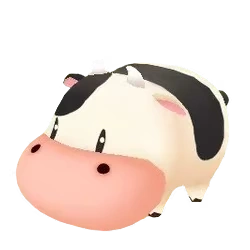 | Calf 5.000 G | DescriptionAdult cows produce Normal Milk every day |
 | Coffe Calf 10.000 G | DescriptionAdult cows produce Coffee Milk every day |
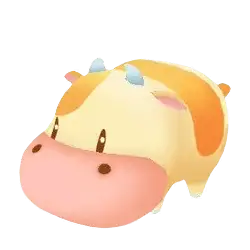 | Fruit Calf 10.000 G | DescriptionAdult cows produce Fruit Milk every day |
 | Strawberry Calf 10.000 G | DescriptionAdult cows produce Strawberry Milk every day |
 | Sheep 4.000 G | DescriptionSheep’s Wool regrows every seven days |
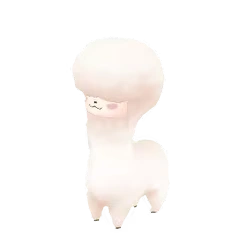 | Alpaca 4.000 G | DescriptionAlpaca’s Wool regrows every seven days |
Animal Care
Purchased animals must be properly cared for to produce high-quality products. This includes feeding them every day, increasing their heart levels, and breeding them.
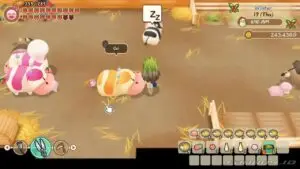
Cows can produce Milk as long as they were fed the previous day.
Feed can be given directly by hand, by letting the animals graze outside the Barn in sunny weather, or by placing Fodder Grass in the feed trough.
When letting cows graze outside the Barn using the bell, make sure the area contains grass they can reach. Otherwise, the cows will go hungry and will not produce Milk the following day.
When you place Fodder Grass in the feed trough, the feed will be consumed at night. Even if you let the cows graze outside on the same day, the Fodder in the trough will still be consumed and disappear the following day.
How to Obtain Fodder Grass
Fodder Grass can be obtained by harvesting grass planted on the farmland.
Unlike previous games in the series, grass harvested in SoS: FoMT will disappear from its tile. However, the remaining grass can spread to nearby empty tiles.
Every day during Spring, Summer, and Autumn, grass has a 25% chance of spreading to one adjacent empty tile.
Grass will continue spreading until it reaches the edge of the field or is blocked by rocks, crops, tree stumps, and weeds. Wood can be used to control the direction in which grass spreads.
Grass that goes dormant during Winter has a 70% chance of growing again when the next season arrives.
Unlike cows, sheep and alpacas will continue growing their Wool even if they are not fed every day.
During Winter, animals can still be let outside the Barn using the bell when the weather is sunny or snowy. However, since grass does not grow during this season, make sure you have enough Fodder Grass to prevent your animals from going hungry.
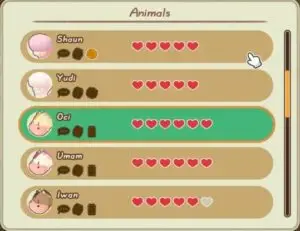
Each livestock animal has a friendship level that can be viewed through the Relationship > Animals menu.
The more hearts an animal has, the higher the quality of its products.
Each heart is worth 24 points. The first heart covers 0–24 points, the second heart covers 25–49 points, and so on.
Animal friendship can be increased in the following ways:
- Talking to the animal.
- Feeding it directly by hand.
- Letting the animal stay outside the Barn for at least 5 hours in sunny or snowy weather.
- Brushing the animal with the Brush.
Each action provides +1 FP per day. Earned FP will not decrease.
Animals with more than 5 hearts can only be obtained through breeding. For more information about how friendship points work, see the FP / LP guide.

Animals purchased from Yodel Ranch have a maximum friendship level of 5 hearts.
To obtain animals with more hearts, you must breed them.
Each offspring will be born with a maximum heart level one level higher than its parent. For example, if the parent has a maximum of 4 hearts, the offspring will have a maximum of 5 hearts.
Therefore, obtaining an animal with 10 hearts requires breeding through multiple generations.
Pregnancy Kit
Mugi sells the Pregnancy Kit for 3,000 G. This item can be used on both normal and special cows.
Use the Pregnancy Kit on the animal you want to breed. For sheep and alpacas, the parent must have Wool before the kit can be used. The Barn must also have enough space for the newborn.
Pregnancy Period
One day after using the Pregnancy Kit, the pregnant animal will move to the birthing area inside the Barn and will not leave until the birth process is complete.
During pregnancy, the animal must be fed every day. If you miss a feeding, the pregnancy period will be extended. Normally, pregnancy lasts 21 days.
Each missed feeding day adds one day to the pregnancy period, up to a maximum of 30 days. If the birth date falls on a festival, the birth will be postponed until the following day.
Cows have two growth stages: Baby and Calf.
A baby cow takes 14 days to grow into a Calf if fed every day. If you miss a feeding, the growth period will increase by one day, up to a maximum of 20 days.
Once it becomes a Calf, it takes another 9 days to become an adult cow. If you miss a feeding, the growth period during this stage will also increase, up to a maximum of 14 days.
Unlike cows, sheep and alpacas have only one growth stage. Their babies take 14 days to become adults if they are fed consistently.
Each missed feeding day extends the growth period, up to a maximum of 20 days.
Products
Milk can be collected using the Milker, which is sold at the Forge for 2,000 G after you purchase your first cow.
Sheep and alpaca Wool can be sheared using the Clipper, which costs 1,800 G. After being sheared, sheep and alpacas need seven days to regrow their Wool.
Products obtained from cows can be processed into Cheese and Butter using the Cheese Maker and Butter Maker, which are sold by Saibara after the Barn has been upgraded.
Meanwhile, Wool and Fleece can be processed into Yarn using the Yarn Maker.
The quality of the Cheese produced is the same as the Milk placed in the Cheese Maker.
Butter, on the other hand, always has the same quality regardless of the quality of the Milk used in the Butter Maker.
| Quality | Requirements | Selling Price |
|---|---|---|
| Milk (S) | Cow has 0–3 hearts | 100 G |
| Milk (M) | Cow has 4–7 hearts | 220 G |
| Milk (L) | Cow has 8–10 hearts | 360 G |
| Milk (G) | Cow has 8–10 hearts and wins the Moo-Moo Festival | 500 G |
| Milk (P) | Cow has 8–10 hearts, wins the Moo-Moo Festival, and spends 1,000 hours outside the Barn | 600 G |
| Milk (X) | 1 in 255 chance from a cow that produces Milk (P) | 800 G |
| Cheese (S) | Process Milk (S) in the Cheese Maker | 250 G |
| Cheese (M) | Process Milk (M) in the Cheese Maker | 380 G |
| Cheese (L) | Process Milk (L) in the Cheese Maker | 540 G |
| Cheese (G) | Process Milk (G) in the Cheese Maker | 700 G |
| Cheese (P) | Process Milk (P) in the Cheese Maker | 820 G |
| Cheese (X) | Process Milk (X) in the Cheese Maker | 1.500 G |
| Butter | Process Milk of any quality in the Butter Maker | 150 G |
| Quality | Requirements | Selling Price |
|---|---|---|
| Coffee, Fruit, or Strawberry Milk (S) | Has 0–3 hearts | 120 G |
| Coffee, Fruit, or Strawberry Milk (M) | Has 4–7 hearts | 240 G |
| Coffee, Fruit, or Strawberry Milk (L) | Has 8–10 hearts | 400 G |
| Coffee, Fruit, or Strawberry Milk (G) | Has 8–10 hearts and wins the Moo-Moo Festival | 550 G |
| Coffee, Fruit, or Strawberry Milk (P) | Has 8–10 hearts, wins the Moo-Moo Festival, and spends 1,000 hours outside the Barn | 660 G |
| Coffee, Fruit, or Strawberry Milk (X) | 1 in 255 chance from a cow that produces Milk (P) | 900 G |
| Quality | Requirements | Selling Price |
|---|---|---|
| Wool (S) | Has 0–3 hearts | 400 G |
| Wool (M) | Has 4–7 hearts | 700 G |
| Wool (L) | Has 8–10 hearts | 1.300 G |
| Wool (G) | Has 8–10 hearts and wins the Fluffy Festival | 2.500 G |
| Wool (P) | Has 8–10 hearts, wins the Fluffy Festival, and spends 1,000 hours outside the Barn | 3.200 G |
| Wool (X) | 1 in 255 chance from Wool (P) | 3.600 G |
| Quality | Requirements | Selling Price |
|---|---|---|
| Alpaca Fleece (S) | Has 0–3 hearts | 420 G |
| Alpaca Fleece (M) | Has 4–7 hearts | 740 G |
| Alpaca Fleece (L) | Has 8–10 hearts | 1.360 G |
| Alpaca Fleece (G) | Has 8–10 hearts and wins the Fluffy Festival | 2.700 G |
| Alpaca Fleece (P) | Has 8–10 hearts, wins the Fluffy Festival, and spends 1,000 hours outside the Barn | 3.500 G |
| Alpaca Fleece (X) | 1 in 255 chance from Wool (P) | 4.000 G |
| Quality | Requirements | Selling Price |
|---|---|---|
| Yarn (S) | Wool or Alpaca Fleece (S) | 530 G |
| Yarn (M) | Wool or Alpaca Fleece (M) | 920 G |
| Yarn (L) | Wool or Alpaca Fleece (L) | 1.400 G |
| Yarn (G) | Wool or Alpaca Fleece (G) | 2.000 G |
| Yarn (P) | Wool or Alpaca Fleece (P) | 2.800 G |
| Yarn (X) | Wool or Alpaca Fleece (X) | 3.200 G |
You can also obtain Milk (X) through cooking recipes after successfully cooking:
- 50 recipes that use Milk (S).
- 25 recipes that use Milk (M).
- 10 recipes that use Milk (L).
Meanwhile, Cheese (X) is obtained after cooking:
- 50 recipes that use Cheese (S).
- 25 recipes that use Cheese (M).
- 10 recipes that use Cheese (L).
There are no special recipes for obtaining Wool (X), Alpaca Fleece (X), or Yarn (X).
Selling Livestock
Unwanted livestock can be sold back to Mugi. The selling price depends on the quality of the products produced by the animal.
| Livestock Type | Calf | S Product | M Product | L Product | G Product | P Product |
|---|---|---|---|---|---|---|
| Normal Cow | 3.000 G | 3.000 G | 4.000 G | 5.000 G | 6.000 G | 7.000 G |
| Coffee, Fruit, dan Strawberry Cow | 4.000 G | 4.000 G | 5.000 G | 6.000 G | 7.000 G | 8.000 G |
| Sheep dan Alpaca | 2.000 G | 2.000 G | 2.500 G | 3.000 G | 4.000 G | 5.000 G |